
How AI Measures Facial Symmetry: The Tech Explained Simply
When you upload your photo to an AI-based facial symmetry tool, it’s easy to be amazed by how quickly it analyzes your face and gives you a symmetry score. But what’s actually happening behind the screen? Let’s break it down in a simple way no tech jargon, just a clear look at how artificial intelligence measures facial symmetry and what makes it so accurate.
Before running your AI face symmetry test, make sure you’ve taken a clear, well-lit photo. If you’re not sure how, check out our detailed guide on how to take the perfect photo for a face symmetry test
The Science Behind Facial Symmetry
Facial symmetry refers to how similar your left and right sides are. In an ideal world, a perfectly symmetrical face would look identical on both halves. However, natural asymmetry exists in everyone it’s what makes faces unique. The role of AI isn’t to judge beauty but to calculate balance through facial symmetry analysis.
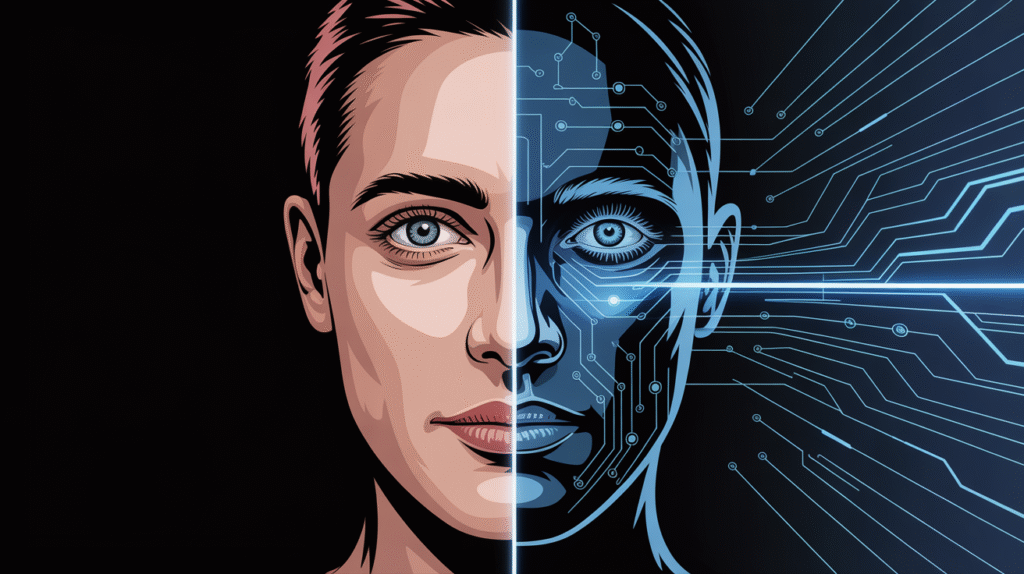
Artificial intelligence does this by studying your facial structure, identifying key landmarks like the eyes, nose, lips, and jawline, and comparing their positions. This digital mapping process forms the base of how AI measures balance and proportion.
Step 1: Facial Detection – Finding the Landmarks
When you upload a photo for an AI face symmetry test, the first thing the system does is detect your face. Using advanced computer vision algorithms, it identifies key facial landmarks typically 60 to 100 points that outline your features.
These landmarks include:
- The corners of your eyes and lips
- The bridge and tip of your nose
- The edges of your jawline and cheekbones
Once these points are mapped, the software mirrors one side of your face to compare it with the other. The goal is to see how closely both sides align.
Step 2: Measuring the Angles and Distances
After the AI finds your facial landmarks, it starts calculating the distances and angles between them. For instance, it checks whether your eyes are level, whether the corners of your lips are even, and how centered your nose is compared to the midpoint of your face.
This process is often powered by machine learning meaning the system has been trained on thousands of facial images to understand what balanced proportions typically look like. The more data it learns from, the smarter and more precise it becomes.
Step 3: Calculating the Symmetry Score
Once all the angles and distances are measured, the AI runs these through a symmetry algorithm that generates your final symmetry score.
This score, usually on a scale from 0 to 100, represents how balanced your facial structure appears based on geometric analysis.
A higher score doesn’t mean you have a “perfect” face it simply means your features are more evenly aligned. Remember, the goal is awareness, not perfection.
Why Lighting and Position Matter
AI can do amazing things, but it still depends heavily on the quality of the photo you upload. Poor lighting, tilted head angles, or uneven shadows can throw off results. To get an accurate facial analysis photo, make sure to:
- Face the camera directly with a neutral expression
- Keep your head straight and your background clear
- Use even lighting on both sides of your face
These small tweaks help the algorithm detect your features correctly and produce a reliable result.
The Technology That Powers It All
Most AI facial symmetry analysis tools rely on two main technologies computer vision and deep learning.
- Computer Vision: Helps the system identify facial landmarks from your photo.
- Deep Learning Models: Analyze patterns and symmetry across millions of faces to refine accuracy over time.
Some tools even use convolutional neural networks (CNNs), which mimic how the human brain processes images, allowing AI to recognize subtle differences in shape, angle, and proportion.
How Accurate Is It, Really?
AI-based symmetry tools can reach accuracy levels of over 95% when provided with clear, front-facing photos. However, the final score can slightly vary between platforms depending on how they define symmetry or what algorithms they use.
That said, AI is significantly more consistent than the human eye. While we might focus on beauty or expression, the algorithm looks purely at geometry measuring distances and angles without bias. This makes AI face symmetry tests a reliable way to track facial balance objectively.
Real-World Uses Beyond Aesthetics
Facial symmetry analysis isn’t just for curiosity or beauty apps. It’s now being used in various industries from cosmetic surgery planning and orthodontics to physical therapy and even mental health research.
For example, doctors use AI facial analysis to monitor recovery after procedures or detect signs of facial muscle weakness. In other cases, stylists and makeup artists use symmetry scores to tailor techniques that enhance facial balance naturally.
The Human Touch Still Matters
While AI provides powerful insights, it doesn’t replace human perception. Your unique expressions, charm, and natural asymmetry are what make you, you. AI helps you understand your facial proportions better, but it’s not a judgment of beauty or worth.
In fact, mild asymmetry is often seen as more natural and expressive. The technology is simply a mirror one that uses data instead of opinions.
Final Thoughts
Artificial intelligence has made facial symmetry analysis easier and more accurate than ever. By combining computer vision with machine learning, it translates complex geometry into simple, understandable results.
So next time you upload a photo for an AI face symmetry test, you’ll know exactly what’s happening behind the scenes a smart algorithm mapping your face, calculating balance, and giving you insights into your unique symmetry story.